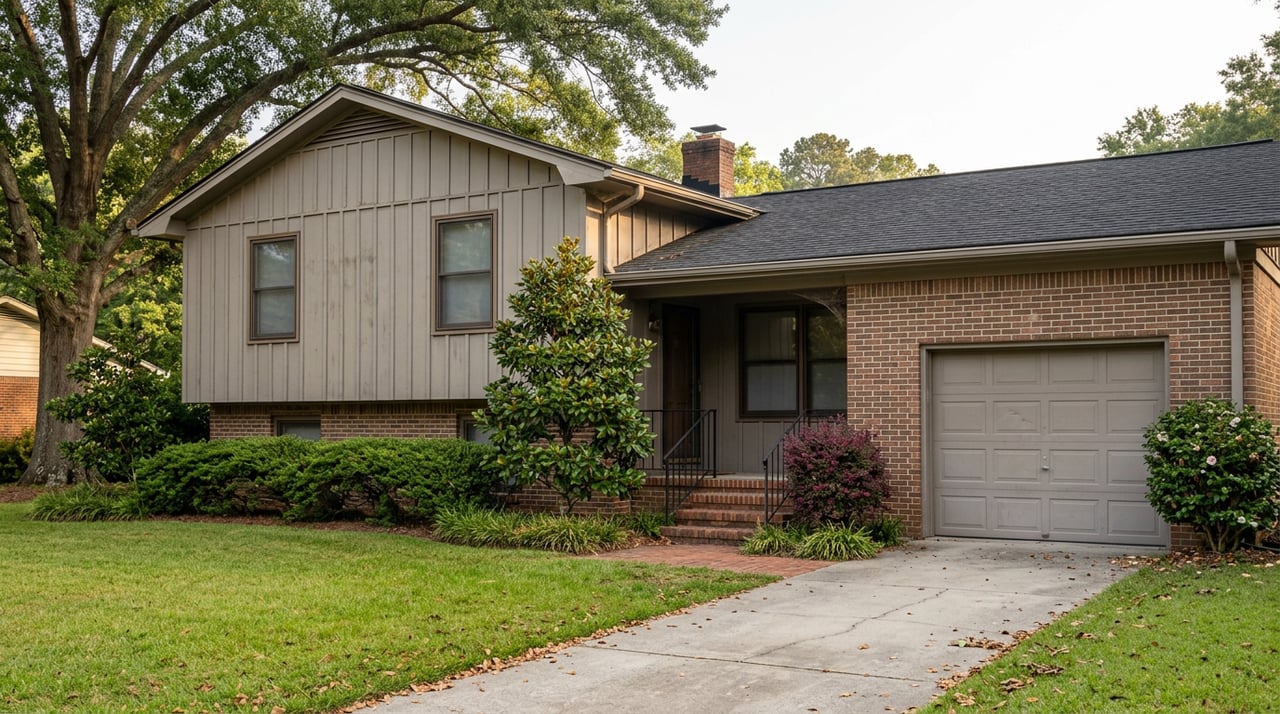
Most West Knoxville suburbs grew the way you'd expect. A developer buys farmland, plats a subdivision, files the HOA covenants, and the strip malls and dentist offices follow once enough rooftops justify them. Farragut and Hardin Valley both grew this way, and it shows up in the paperwork buyers see at closing: architectural review boards, common-area assessments, a management company collecting dues twice a year.
Cedar Bluff grew backward. The commercial corridor came first, and the neighborhood is still catching up to it. That reversal is the reason a Cedar Bluff ranch house rarely comes with an HOA fee, why the housing stock skews older even as new apartments keep landing, and why the same office parks that make the area feel less like a subdivision and more like a business park are quietly what make it work as a rental property.
The Sequencing Almost No One Notices
The name itself is a clue. Cedar Bluff took its name from a small quarry where cedar-colored marble was mined and an artificial bluff was carved into a hillside, and the road that ran through what was then farmland picked up the name Cedar Bluff Road. Commercial growth along that road accelerated once the I-40/I-75 interchange went in during the 1970s, and the corridor never really stopped building out from there.
Today Cedar Bluff sits at the heart of one of Knoxville's major commercial corridors and hosts a regional headquarters for Discovery, Inc. It's also home to many of West Knoxville's office and technology parks, a concentration that traces directly to its proximity to Oak Ridge National Laboratory. The neighborhood sits west of West Hills and east of Pellissippi Parkway, reachable by Cedar Bluff Road, Park West Boulevard, and State Route 169, which most people know as Middlebrook Pike.
The residential pockets tucked between those office parks were largely built during the same stretch of decades, ranch and split-level homes on generous lots that predate the corridor's densification rather than being purpose-built to serve it. That's the reversed order. The commercial infrastructure showed up to serve a growing employment base, and the houses came along as incidental infill on whatever land hadn't already gone to an office building or a shopping center.
What the Reversed Order Means for Your HOA Line Item
Compare that sequence to how Farragut and Hardin Valley built out. Both took shape as residential-first developments, with subdivisions platted and marketed to buyers before the retail followed, and the HOA structure came bundled in from day one to manage the shared landscaping, entrances, and amenities that make a new subdivision feel finished. Cedar Bluff's older subdivisions never needed that structure because they weren't sold as a package deal with a clubhouse and a stocked pond. They're standalone ranch and traditional homes on individual lots, and most of them were never assigned to an HOA in the first place.
| Cedar Bluff | Farragut | Hardin Valley | |
|---|---|---|---|
| Typical build era | 1960s-1970s, with condo and apartment infill ongoing | Mostly newer construction, still actively building | Mix of established and newer subdivisions |
| Dominant home style | Ranch, split-level, traditional | Modern traditional, new construction | Traditional and modern farmhouse |
| HOA prevalence | Largely absent in older subdivisions | Common in newer developments | Common in newer developments |
| Commercial anchor | Built into the neighborhood itself | Town Center, separate from most residential streets | Retail corridor along Hardin Valley Road |
That last row is the one worth sitting with. In Farragut and Hardin Valley, the commercial anchor is a destination you drive to. In Cedar Bluff, it's the neighborhood's organizing feature. You don't drive to the office park corridor, you live inside it.
A Cedar Bluff ranch house sells you a quiet street with a corporate parking lot as its horizon line, and that horizon line is doing more for the property's rental math than anyone puts in the listing description.
The New Construction Filling in Behind the Old Stock
The commercial-first pattern hasn't stopped. It's just changed shape. Newer apartment and condo development has been adding residential population to what was historically a commercial-first district, which is a polite way of saying the corridor is now building density into itself rather than expanding outward. Element at Cedar Bluff, one of the newer communities along the corridor, listed studio units starting near $1,100 a month and two-bedroom floor plans in the $1,300 to $1,400 range as of summer 2026, with move-in dates stretching into September. Goldelm at Cedar Bluff, a garden-style community near West Town Mall, represents the same pattern from a different developer.
None of this is replacing the ranch and split-level resale stock. It's stacking on top of it, so a buyer can walk two blocks from a decades-old basement rancher and find a leasing office advertising brand-new one-bedroom units, both of them technically in the same subdivision cluster, both technically zoned into the same commercial-adjacent footprint that's defined Cedar Bluff since the interchange went in.
Why That Backfill Makes Cedar Bluff a Quiet Rental Play
For an investor, the reversed sequencing is the appeal, not the complication. West Knoxville pockets near Cedar Bluff combine retail access, employment centers, and a genuine mix of housing stock, which is the kind of balance that supports both cash flow and lower vacancy risk. Proximity to a concentrated job center, in this case the office and tech parks tied to Oak Ridge and to companies like Discovery, means a property here draws from a commuter base that doesn't evaporate the way a purely bedroom-community rental might during a slow season.
The math is straightforward once you see it. Knoxville's average home value stood at $376,648 as of June 2026, up 1.0 percent over the prior year, and Cedar Bluff's older ranch and split-level resales routinely list well under that citywide figure. Pair a below-average purchase price with an HOA-free ownership structure and a built-in renter pool commuting to the corridor's own office parks, and you get a rental property with fewer moving parts than a comparable investment in a newer, covenant-heavy subdivision. It's not a flashy pitch. It's a quiet one, which is probably why it doesn't get marketed as an investment hotspot the way Turkey Creek or downtown loft conversions do.
What This Means If You're Comparing Neighborhoods
For an owner-occupant weighing Cedar Bluff against Farragut or Hardin Valley, the decision comes down to what you're trading for what. Cedar Bluff gets you no HOA dues, an older but often larger lot, and walkable proximity to the retail corridor along Cedar Bluff Road and Kingston Pike, plus a stretch of green relief in the 10 Mile Creek Greenway, which threads through the neighborhood on its way to Walker Springs Park. What you give up is the newer construction and the more insulated, subdivision-first feel that Farragut and Hardin Valley are built around. You're buying into a corridor that was designed for commerce first and retrofitted for residents second, and depending on what you want out of a neighborhood, that's either the whole appeal or the thing to weigh carefully before you make an offer.
For an investor, the same fact reads differently. The commercial-first sequencing that keeps HOA fees off the closing statement is the same sequencing that keeps a renter pool employed a short drive from home. That's not a coincidence built into the marketing. It's built into the zoning history, and it's the kind of detail that doesn't show up on a listing sheet no matter how many photos of the kitchen you scroll through.
If you're comparing Cedar Bluff against other West Knoxville neighborhoods for a purchase or trying to figure out whether a specific property here pencils out as a rental, Terri Lawson can walk through the specifics with you. Let's Connect.
