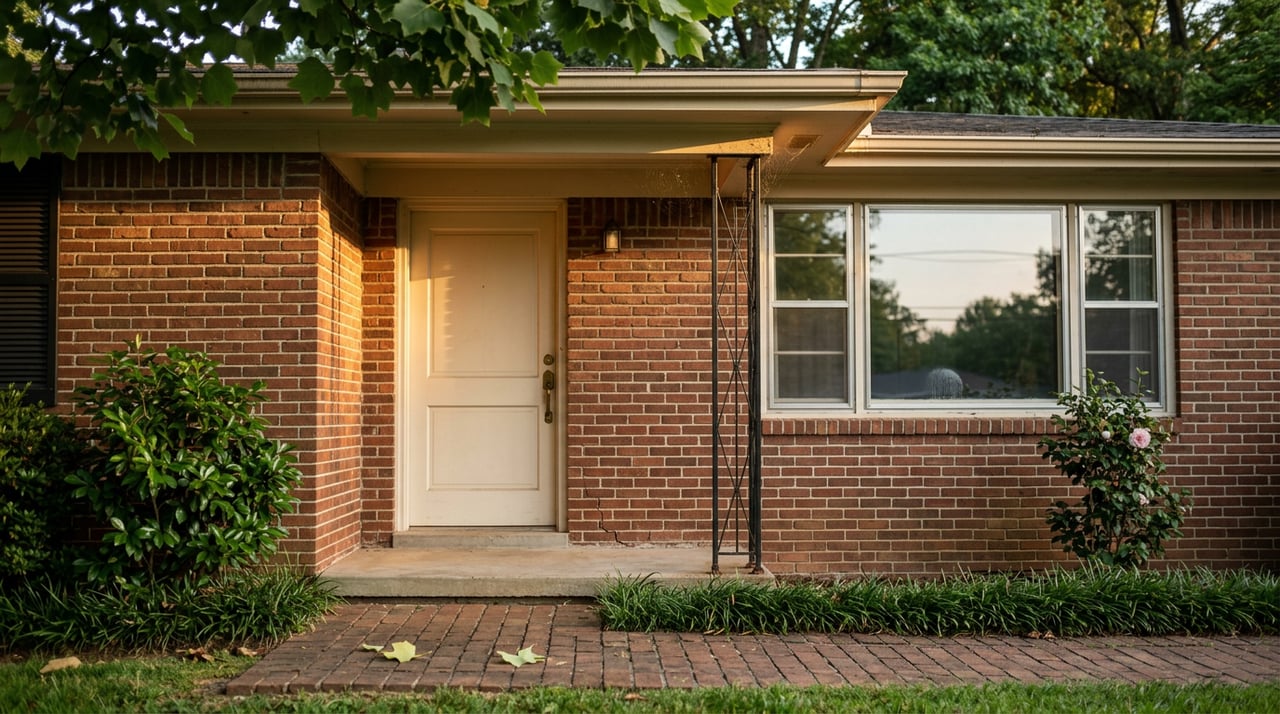
A West Hills rancher can look finished. New paint, refinished hardwood, a kitchen with quartz counters and a farmhouse sink standing in for the original 1950s galley. The listing photos show none of what's actually aging on schedule underneath the slab: drain pipe that went into the ground the same year the house did, and that is now old enough to start failing on its own.
That gap between what a buyer sees and what a buyer inherits is the real story in West Hills right now. Not because the neighborhood has a problem. Because the neighborhood has an age, and that age is unusually uniform for a Knoxville subdivision.
A neighborhood built inside one narrow window
West Hills wasn't assembled in phases over forty years the way a lot of Knoxville suburbs were. It went up fast, in a fairly tight construction window, as Knoxville's first major post-World War II subdivision. Developer Morgan Schubert bought up several farms along Kingston Pike, including the Walker, Kirby, Hickey, and Van Osdale properties, and turned them into the neighborhood that exists today. The 1954 Parade of Homes on Stockton Drive introduced the first wave of buyers to the area, and the Hotpoint Living-Conditioned House on West Hills Road, designed by Knoxville architect Bruce McCarty and later added to the National Register of Historic Places in 2010, became the neighborhood's architectural signature. Residents formed what would become the West Hills Community Association in the early 1960s specifically to keep commercial development from creeping in, and in 1972 that group worked with the city to write the West Hills Plan.
None of that is trivia. It tells you when the pipes went in. If a house sold during that original wave, it's now sitting somewhere between 66 and 72 years old in 2026. That's not an estimate pulled from a general sense of "older neighborhood." It's a direct read from the construction record.
The pipe math nobody puts on a listing sheet
Cast iron was the standard material for residential drain, waste, and vent systems from the 1950s through the early 1980s. It was chosen because it was strong and quiet, and it can genuinely last a long time in the right conditions, sometimes close to a century. But most plumbing and inspection sources converge on a narrower practical window: problems tend to start showing up somewhere between 50 and 70 years in, as corrosion works from the inside out and the pipe wall thins until it develops pinhole leaks or starts collapsing under its own weight.
Run that math against West Hills' construction dates and the overlap is almost exact. A house built in 1957 is 69 years old this year. A house built in 1962 is 64. Those aren't edge cases in the failure curve, they're the middle of it. What makes West Hills different from a lot of Knoxville subdivisions isn't that some homes have old pipe. It's that most of the original stock was built inside the same eight-to-ten-year window, which means a large share of the neighborhood's plumbing is aging through that failure zone at roughly the same time.
Why the standard inspection won't tell you this
A general home inspection covers what's visible and accessible. It is not designed to run a camera through your drain line, and most inspectors will say so directly. Seeing the condition of a cast iron stack or a clay sewer lateral requires a separate camera scope, usually arranged through a plumber rather than the home inspector, and it typically runs a few hundred dollars.
There's a second piece of this that catches buyers off guard just as often. The sewer lateral, the pipe that runs from the house out to the connection with the city's main line, is the homeowner's responsibility to maintain and repair, not the City of Knoxville's. That responsibility doesn't stop at the property line. It follows the pipe under the yard, the driveway, and in some cases the sidewalk. A buyer who assumes a failing line out near the street is a city problem is going to be surprised at closing, or worse, six months after closing.
Watch for the practical warning signs before a failure becomes an emergency:
- Drains that clog repeatedly across more than one fixture
- Gurgling sounds from toilets or nearby drains
- Sewage odor near floor drains, the basement, or the yard
- Soggy patches or unusually green grass in one part of the lawn
- Water backing up into a tub or shower when a toilet flushes
Any one of these on its own might be a simple clog. Two or three together, in a house built in the 1950s or early 1960s, is worth a scope before it's worth a snake.
What replacement actually costs
Sewer line replacement pricing generally runs in the range of roughly $50 to $250 per linear foot depending on depth, access, and whether the job goes trenchless or traditional, according to national contractor cost guides. Trenchless methods, which use pipe bursting or a resin liner instead of an open trench, tend to save the yard and the driveway from being torn up and can often be completed in a day or two rather than stretching across a traditional dig. For a full interior cast iron stack replacement rather than just the lateral, national contractor estimates commonly land in five figures before you add back drywall, flooring, or any finish work disturbed along the way.
None of that is a reason to walk away from a West Hills ranch. It's a reason to know the number before you're the one paying it as a surprise instead of a negotiated repair credit.
What this actually explains about this year's prices
West Hills pricing data from mid-2026 doesn't agree with itself, and that disagreement is the tell. One source put the July 2026 median list price at $624,000. Another put the June 2026 median sale price at $522,000, with the trailing twelve-month median sitting closer to $499,900. A third estimate landed near $567,000. Listings this year have spanned from under $280,000 to over $1.2 million.
Square footage and finishes explain part of that range. But in a neighborhood where most of the housing stock was built within the same decade, a meaningful part of the spread comes down to something buyers can't see from the street: whether a given house has already had its original plumbing scoped, repaired, or replaced, or whether that work is still sitting ahead of the next owner. Two ranches with nearly identical curb appeal can carry very different real costs depending on which side of that line they fall on, and that's exactly the kind of gap a good buyer's agent should be pricing into an offer, not discovering after close.
What to do with this if you're on either side of a West Hills deal
If you're under contract on a West Hills home built before the early 1970s, ask specifically for a sewer camera scope as part of due diligence, separate from the general inspection. If you're preparing to list one, consider getting that scope done ahead of time. A clean scope becomes a selling point. A known issue becomes a repair credit you control instead of a renegotiation you don't.
A few questions worth asking directly
Does homeowners insurance cover a collapsed sewer lateral? Usually not if the cause is ordinary wear and corrosion. Coverage is more likely if the damage traces to something sudden, like a fallen tree.
Is cast iron plumbing automatically a dealbreaker? No. Plenty of cast iron systems are still functioning fine at 70 years, particularly in favorable soil conditions. The point isn't to assume failure, it's to stop assuming you'd know if it were happening.
How much does a scope itself cost, separate from any repair? Generally a few hundred dollars, which is a small number next to what it protects you from not knowing.
If you're weighing a West Hills ranch, or getting one ready to list, Terri Lawson can walk through what a scope actually turns up in this neighborhood and how to build it into your offer or your pricing strategy before it becomes a surprise instead of a plan. Let's Connect.
